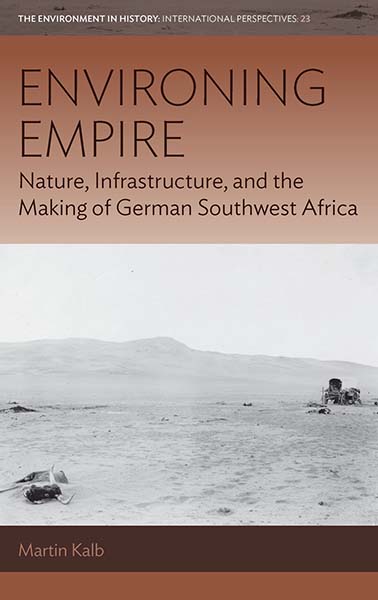
My recent book focuses on infrastructure and the making of German colonial Southwest Africa (1884-1915, modern-day Namibia). In 2014, I began looking into the German settler community during colonial rule. I shared initial thoughts on the coastal town of Swakopmund and German efforts to make it the main entry point in Environment and History. Two side projects took shape as well. After stepping into the Swakopmund Buchhandlung (Namibia) I was struck by an array of reprints – and nostalgic and apologetic efforts to promote those without context (Archiving Settler Colonialism); widespread debates about dowsing (including silences of indigenous expertise) also warranted a separate article (German History).
My book titled Environing Empire: Nature, Infrastructure, and the Making of German Southwest Africa, partially funded thanks to a NEH summer grant (2019), was published in 2022. Environing Empire uses the concept of “environmental infrastructure” (Emmanuel Kreike) to explore the making of German Southwest Africa. Chapters investigate the role of human ingenuity and labor, as well as non-human agents and natural forces to better understand the formation of a colony. Along the way, I deconstruct settler narratives framed around the heroic conquest of nature that silence everyday colonial violence and genocide – and still haunt much of the scholarship as well as public debates. Environing Empire is available in open access (pdf or epub); it is also available in paperback for around 20 USD.
Federico Pirino (Columbia University / Sciences Po), H-Sci-Med-Tech, 2025: “Kalb’s key contribution ultimately lies in his articulation of “cluttered agencies” and in his foregrounding of the entangled roles of human and nonhuman actors in shaping the trajectory of German colonial expansion in Southwest Africa (p. 271). By tracing how terrain, climate, disease, animals, and coerced African labor interacted with colonial aspirations, Kalb dismantles sanitized narratives of infrastructural triumph and settler perseverance. His analysis exposes the limits of imperial agency, showing how colonial projects were continuously negotiated, disrupted, and reconfigured by forces well beyond the control of metropolitan planners or local administrators. In doing so, Environing Empire challenges the linear modernist scripts that animated colonialism and its claims of order and rationality. Kalb’s emphasis on contingency, resistance, and environmental friction reveals a colonial enterprise haunted by uncertainty, contradiction, and violence. Rather than a story of progressive development, the making of environmental infrastructure appears here as a deeply political, often brutal process in which domination was never fully secured. By centering the silenced roles of African laborers and the unruly materialities of the landscape, Kalb’s work offers a compelling corrective to lingering colonial mythologies and opens new pathways for understanding empire as a project shaped as much by its failures and improvisations as by its ambitions.”
Jules Skotnes-Brown (University of St. Andrews), H-Environment, 2025: “Kalb makes three major contributions: First, he shows the importance of the environment in understanding how natural forces have both enabled and hindered colonization. Second, he powerfully demonstrates how both the environment and German technology-driven wars of conquest against nature and Naturvoelker (the term Germans used for Indigenous people) became a key part of colonial narratives and German settler identities. Finally, he shows how nonhuman forces truly matter to African history, and to colonial history more generally…..Environing Empire is ultimately a master class in writing more-than-human histories of both colonialism and African countries. It deserves the greatest success and the highest praise.”
Philipp Lehmann (UC Riverside), Central European History, 2024: “Richly illustrated with a multitude of photographs, maps, and drawings, Environing Empire manages to connect the themes of conquest, transformation, and destruction in an admirably comprehensive and analytical fashion. It shines in combining the extensive literature of German Southwest Africa with new material on infrastructural projects that, as Kalb argues persuasively, are vital for understanding German colonial designs and failures. The book succeeds in foregrounding the often-forced labor of Africans that was crucial for German projects in the colony.”
 Martin Kalb